AI TRAINING THAT TURNS TOOLS INTO REAL BUSINESS SKILLS
Your team already has access to AI. We help them understand what to do with it, how to use it effectively, and where it can actually make their work easier.
eCreek provides practical, role-based AI training built around your people, your workflows, and the tools you already use. From ChatGPT and Microsoft Copilot to Claude, Gemini, Hatz, and other AI platforms, we help your team move beyond experimentation and start using AI consistently across the business.
YOUR TEAM HAS AI. ARE THEY ACTUALLY USING IT?
Buying an AI tool does not automatically make a business AI-enabled.
One employee may use AI every day. Another may have opened Copilot twice. Someone else may have developed a great prompt that nobody else knows exists. And entire departments may still be doing work manually that AI could help complete in minutes.
eCreek helps close that gap by showing your people how AI fits into the work they already do.
We focus on practical use, repeatable habits, and real business workflows so AI becomes part of how your team operates instead of another tool sitting in the technology stack.
WHAT AI TRAINING WITH eCREEK LOOKS LIKE
Not Generic AI Training. Training Built Around Your Business.
Your accounting team does not need the same AI training as your sales team. Your leadership team does not need the same workflows as your operations team.
That is why we do not approach AI enablement as a one-size-fits-all seminar.
We look at how different roles across your organization actually work and help your people identify where AI can save time, improve consistency, accelerate research, create better first drafts, and reduce repetitive work.
Understand the tools.
Build practical AI literacy so employees understand what AI can do, what it cannot do, and how to work with it effectively.
Training can include the AI platforms your organization already uses, including ChatGPT, Copilot, Claude, Gemini, Hatz, and more.
Put AI into real work.
Move beyond demonstrations and generic prompts.
We work through real tasks your employees perform every day and show them how AI can support those workflows.
Turn individual wins into shared practices.
When someone discovers a great way to use AI, it should not stay with one person.
We help build shared prompt libraries, repeatable workflows, and internal best practices your entire team can use.
TRAINING BUILT AROUND THE TOOLS YOU ALREADY HAVE
You Do Not Necessarily Need Another AI Platform.
You may already have more AI capability than your team realizes.
Microsoft 365 environments increasingly include Copilot capabilities. Employees may already be experimenting with ChatGPT, Claude, Gemini, or other tools. Your organization may also have a managed private AI environment through eCreek.
Before adding another piece of software, we help you understand what you already have and how your team can get more value from it.
Training Can Include:
- ChatGPT
- Microsoft Copilot
- Claude
- Gemini
- Hatz
- Other approved AI tools already used by your organization
The goal is not to make everyone an AI expert.
The goal is to make your people better at the jobs they already have.
MAKE YOUR PEOPLE BETTER AT THE JOBS THEY ALREADY HAVE.
WHAT DOES ROLE-BASED AI TRAINING ACTUALLY MEAN?
Different Teams. Different Work. Different AI Opportunities.
AI becomes much easier to understand when employees can immediately connect it to their own responsibilities.
LEADERSHIP
Summarize information, prepare for meetings, analyze ideas, draft communications, and accelerate decision support.
SALES
Research prospects, prepare for meetings, draft follow-ups, summarize notes, and create stronger first drafts.
MARKETING
Brainstorm campaigns, repurpose content, research topics, develop drafts, and accelerate content workflows.
OPERATIONS
Document processes, summarize information, organize data, develop SOPs, and identify repetitive work.
HR + ADMINISTRATION
Draft internal communications, organize documentation, develop training materials, and streamline routine administrative work.
FINANCE
Summarize information, assist with documentation, organize data, and support repeatable analytical workflows.
The exact workflows we train around depend on your business, your approved AI tools, and how your teams work today.
FROM AI DRIFTER TO PROMPTED OPERATOR
Training Is Where AI Starts Becoming Repeatable.
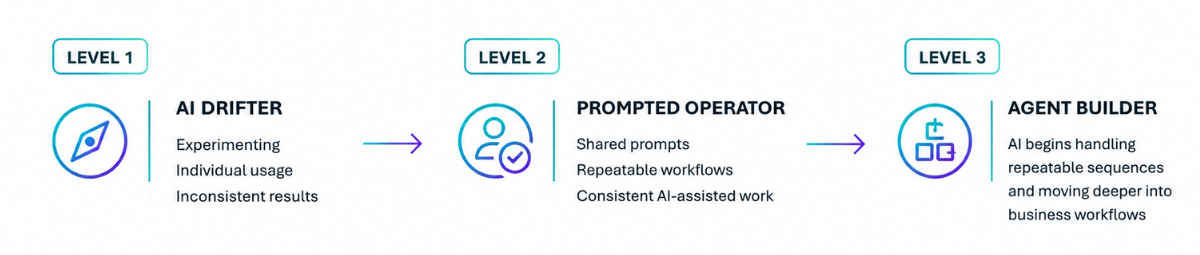
At Level 1 of eCreek’s AI Maturity Model, AI use tends to be sporadic and unofficial. Different people experiment with different tools, results are inconsistent, and personal-account “shadow AI” can become common.
At Level 2, that begins to change.
Teams start using AI intentionally. Shared prompt templates appear. Employees develop repeatable habits. AI becomes a standard first-draft engine for specific, high-frequency tasks.
That shift is exactly what TRAIN is designed to create.
TRAINING IS ONLY ONE PART OF AI ADOPTION
The Best AI Strategy Connects People, Policy, and Technology.
Training works best when employees also know which tools they should use, what information they can put into them, and how AI fits into the organization’s broader strategy.
That is why eCreek’s AI services work together.
GOVERN
Set the rules, policies, and oversight.
DEPLOY
Give employees a secure, managed AI environment.
TRAIN
Build the skills and repeatable habits.
BUILD + CONNECT
Turn successful workflows into agents, automations, and integrations.
WHO IS AI TRAINING FOR?
AI training is a strong fit if:
- Your employees are already experimenting with AI, but usage is inconsistent.
- You purchased AI tools and adoption has been lower than expected.
- Employees keep asking what they are actually allowed to use.
- A few people have become your unofficial “AI people.”
- Different employees get dramatically different results from the same tools.
- You want to identify practical AI use cases before investing in automation.
- You want AI to become an organizational capability instead of an individual experiment.
YOU DON'T HAVE TO FIGURE OUT AI ADOPTION ALONE
Give Your Team More Than Access to AI. Give Them a Way to Use It.
The companies that get the most from AI will not simply be the companies that buy the most tools.
They will be the companies that teach their people how to use AI well, create repeatable ways of working, and continuously turn successful experiments into better processes.
eCreek helps you build that capability from the inside out.
FAQ
Frequently Asked Questions About AI Training
What AI tools can eCreek train our team on?
Training can be built around the AI tools your organization already uses, including ChatGPT, Microsoft Copilot, Claude, Gemini, Hatz, and other approved platforms.
Is this a general AI training class?
No. eCreek’s approach is role-based and focused on practical business use. We want employees to leave understanding how AI applies to the work they actually perform.
Do we need to use Hatz for AI training?
No. Training can be built around the tools your organization already owns or has approved. If your organization needs a secure, managed AI environment, eCreek can also help through our Deploy services.
Can you train different departments differently?
Yes. That is one of the primary advantages of role-based training. Leadership, sales, marketing, operations, finance, HR, and other teams often have very different AI opportunities.
Can you help us create prompts for our business?
Yes. Shared prompt libraries and repeatable prompt templates are a core part of moving from inconsistent experimentation toward more mature AI adoption.
What if our employees are at very different skill levels?
That is normal. AI adoption rarely happens evenly across an organization. Training can help establish a common baseline while also identifying employees and workflows that are ready for more advanced use.
Can training help us identify processes to automate?
Yes. Training often reveals repetitive, high-value workflows that are good candidates for standardization, AI agents, integrations, or custom development.
Where should we start?
Start by understanding where your organization sits today. eCreek’s AI Maturity Model helps identify whether your team is experimenting, using AI consistently, building agents, managing AI workflows, or moving into more advanced integrations.