Managed IT vs. In-House IT for Colorado Businesses
If your Colorado business has 20 to 50 employees and IT is starting to slow your team down, you are probably facing an important decision:
Should you hire an in-house IT employee or partner with a managed IT services provider?
The right answer depends on your business, budget, compliance needs, and growth plans. However, for many small and mid-sized Colorado companies, the real cost difference is larger than expected.
An in-house IT hire may seem straightforward at first. You pay one salary and have someone available during the workday. But once benefits, payroll taxes, equipment, training, time off, recruiting, and limited coverage are included, the total cost can rise quickly.
A managed IT provider, also known as an MSP, gives your business access to a broader IT team for a predictable monthly cost. That can include helpdesk support, cybersecurity monitoring, patch management, cloud support, vendor coordination, backup management, and strategic IT planning.
This guide breaks down the real cost of both options so you can make a practical decision for your Colorado business.
What Does an In-House IT Hire Actually Cost in Colorado?
Hiring one IT generalist in the Denver metro area often costs more than the base salary alone.
A typical IT hire may include expenses such as:
- Base salary
- Payroll taxes
- Health insurance and benefits
- Paid time off
- Recruiting costs
- Onboarding time
- Hardware and software tools
- Certifications and training
- Management oversight
For many Colorado businesses, a single IT generalist can cost roughly $85,000 to $115,000 per year once total employment costs are included.
That number may increase if you need someone with advanced cybersecurity, cloud, compliance, or network engineering experience.
The Hidden Cost of One IT Person
The bigger issue is not only cost. It is coverage.
One IT employee is often expected to handle:
- Helpdesk tickets
- Password resets
- Network issues
- Software updates
- Cybersecurity alerts
- Vendor management
- Backup checks
- Compliance requests
- Cloud support
- Employee onboarding and offboarding
- Long-term IT planning
For a 20 to 50 person company, that is a wide range of responsibilities for one person.
There is also a continuity risk. When that employee is out sick, on vacation, overloaded, or leaves the company, your business may lose its only source of IT knowledge.
What Does Managed IT Cost for a 20 to 50 Person Business?
Managed IT services for a company with 20 to 50 employees often cost less than hiring a full-time IT employee, especially when you compare total coverage.
A managed IT services agreement typically falls somewhere between $1,500 and $6,000 per month, depending on:
- Number of users
- Number of devices
- Helpdesk requirements
- Cybersecurity tools included
- Backup and disaster recovery needs
- Cloud environment complexity
- Compliance requirements
- Response time expectations
- On-site support needs
That equals about $18,000 to $72,000 per year.
At the lower end of the 20 to 50 employee range, managed IT is often significantly less expensive than hiring in-house. At the higher end, the cost may be comparable, but the business usually gets broader expertise, better coverage, and more predictable support.
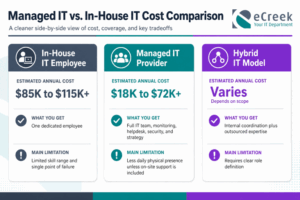
A side-by-side visual guide comparing the cost, coverage, and limitations of in-house IT, managed IT services, and hybrid IT support models.
For many Colorado businesses, the question is not simply, Which option is cheaper?
The better question is:
Which option gives us the right coverage, response time, cybersecurity, and scalability for the money?
What You Get With a Managed IT Partner
A Full IT Team Instead of One Generalist
When you hire one IT employee, you are hiring one person’s skill set.
When you work with a managed IT provider, you gain access to a team with experience across:
- Helpdesk support
- Networking
- Cybersecurity
- Cloud platforms
- Compliance
- Microsoft 365
- Backup and recovery
- Vendor management
- IT strategy
This matters because most IT problems do not fit neatly into one category. A slow network, failed backup, phishing attempt, or Microsoft 365 issue may require different types of expertise.
More Consistent Response Times
A single employee can only handle one issue at a time.
A managed IT team can route requests based on urgency, skill set, and availability. That helps reduce downtime and keeps employees productive.
At eCreek IT Solutions, our average response time is under 15 minutes, which is difficult for a single in-house employee to consistently match while also managing projects, maintenance, and security.
Proactive Monitoring and Maintenance
In-house IT often becomes reactive because one person is busy handling daily requests.
Managed IT is designed to be proactive.
That means your systems can be monitored for:
- Security alerts
- Patch failures
- Backup issues
- Device health
- Network performance
- Suspicious activity
- Software problems
The goal is to catch problems before they become business disruptions.
Stronger Cybersecurity Coverage
Cybersecurity is no longer optional for small and mid-sized businesses.
A managed IT provider can help support:
- Endpoint protection
- Email security
- Multi-factor authentication
- Security awareness training
- Patch management
- Backup protection
- Account permission reviews
- Incident response planning
For many 20 to 50 person companies, building this level of cybersecurity in-house is expensive and difficult.
Compliance Support for Regulated Industries
Colorado businesses in healthcare, legal, financial, manufacturing, construction, and nonprofit sectors may have specific compliance needs.
A managed IT partner can help with technology controls related to:
- Data access
- User permissions
- Backup retention
- Security documentation
- Device management
- Vendor risk
- Audit preparation
This does not replace legal or compliance counsel, but it can give your business the technical support needed to stay better prepared.
Scalability as Your Business Grows
Hiring IT staff takes time. Recruiting, interviewing, onboarding, and training can take weeks or months.
Managed IT can scale more easily as your business adds:
- New employees
- New locations
- Remote workers
- Cloud applications
- Security requirements
- Compliance obligations
For growing Colorado businesses, this flexibility can be a major advantage.
When Does Hiring In-House IT Make Sense?
Hiring in-house IT can be the right choice in certain situations.
It may make sense if your business:
- Has highly specialized internal systems
- Requires constant on-site technical support
- Has complex proprietary software
- Is large enough to support a full IT department
- Needs daily internal technology leadership
- Already has mature IT processes and security tools
In-house IT can work well when the role is clearly defined and the business has enough budget to support more than one person over time.
For many companies in the 20 to 50 employee range, however, hiring one person often creates a coverage gap. One employee may be expected to act as helpdesk technician, cybersecurity analyst, network engineer, cloud administrator, and IT strategist.
That is usually not realistic.
When Is Managed IT the Better Fit?
Managed IT is often a strong fit when your business needs reliable IT support without the cost of building a full internal IT department.
It may be the better option if your company:
- Has 20 to 50 employees
- Needs predictable monthly IT costs
- Wants faster helpdesk response
- Has limited internal IT knowledge
- Needs cybersecurity support
- Uses Microsoft 365 or cloud tools
- Has remote or hybrid employees
- Must meet compliance expectations
- Wants IT planning, not just break-fix support
- Cannot afford downtime
For many small and mid-sized businesses, managed IT provides the right balance of cost, coverage, and expertise.
A Simple Way to Think About the Decision
Ask yourself this question:
Do we need one dedicated IT person sitting in our office every day, or do we need reliable IT support available whenever something comes up?
For many Colorado businesses, the answer is the second option.
You may not need someone physically present every day. You need systems that work, employees who get fast help, cybersecurity that is monitored, and technology planning that supports growth.
That is where a managed IT partner can deliver strong value.
Managed IT vs. In-House IT: Which Costs Less?
In many cases, managed IT costs less than hiring a full-time IT employee.
For a 20 to 50 person Colorado business, an in-house IT employee may cost $85,000 to $115,000 or more per year when fully loaded employment costs are included.
Managed IT may cost $18,000 to $72,000 per year depending on the number of users, support needs, cybersecurity tools, and compliance requirements.
The more important comparison is value. Managed IT often provides access to a broader team, better coverage, proactive monitoring, cybersecurity tools, and strategic guidance for a more predictable monthly cost.
Frequently Asked Questions
Can We Use a Managed IT Provider Alongside an In-House IT Employee?
Yes. This is called a hybrid IT model, and it is common for growing businesses.
Your internal employee can handle daily coordination, company-specific systems, and on-site needs, while the managed IT provider supports cybersecurity, monitoring, backup management, escalation support, compliance, and strategic planning.
What Is Included in a Managed IT Contract?
A strong managed IT agreement may include:
- Helpdesk support
- Remote monitoring
- Patch management
- Endpoint security
- Microsoft 365 support
- Backup monitoring
- Vendor coordination
- Cybersecurity tools
- Network support
- IT planning
- Defined service level agreements
Before signing, ask each provider for a clear scope of services so you know exactly what is included.
Is Managed IT Right for Nonprofits?
Yes. Managed IT can be a practical option for nonprofits because it provides professional support without the overhead of a full-time IT hire.
Many nonprofits have lean teams, limited budgets, donor data, compliance concerns, and remote work needs. A managed IT partner can help protect systems, support staff, and plan technology improvements in a cost-effective way.
eCreek IT Solutions offers nonprofit-specific pricing for eligible organizations.
Is Managed IT Better Than Hiring IT Staff?
Managed IT is not always better, but it is often more practical for small and mid-sized businesses.
If your business needs one person on-site every day, in-house IT may be the better choice. If you need broad support, cybersecurity, monitoring, and predictable costs, managed IT is often the stronger option.
How Much Should a Small Business Budget for IT Support?
A 20 to 50 person business should budget based on users, devices, risk, cloud tools, compliance needs, and response time expectations.
Many businesses in this size range compare the cost of one internal IT hire against the monthly cost of managed IT services. The best option depends on how much support, security, and strategic guidance the business needs.
What Questions Should We Ask Before Choosing a Managed IT Provider?
Ask potential providers:
- What is included in your monthly agreement?
- What is not included?
- What is your average response time?
- Do you provide cybersecurity monitoring?
- Do you support compliance requirements?
- Do you offer on-site support in Colorado?
- How do you handle after-hours issues?
- What tools are included in your service?
- How do you document our environment?
- Will we have regular strategy reviews?
Clear answers to these questions can help you avoid surprise costs and service gaps.
Final Recommendation
For many 20 to 50 person Colorado businesses, managed IT offers a better balance of cost, coverage, and expertise than hiring one in-house IT employee.
An in-house hire can be valuable, especially for companies with specialized systems or daily on-site needs. But one person can only do so much.
A managed IT partner gives your business access to a team, proactive monitoring, cybersecurity support, helpdesk coverage, and strategic planning without the cost and risk of relying on a single employee.
If your company is growing, dealing with recurring IT issues, or unsure whether to hire internally, comparing the full cost of both options is the right next step.
eCreek IT Solutions helps Colorado businesses choose practical, secure, and scalable IT support models that fit their size, budget, and goals.